Current pilot focus
Automotive HARA chain and TARA
Pilot workflows focus on project context, Item Definition, HARA, Safety Goals, TARA, review queues, traceability, source grounding, and evidence readiness.
Platform walkthrough
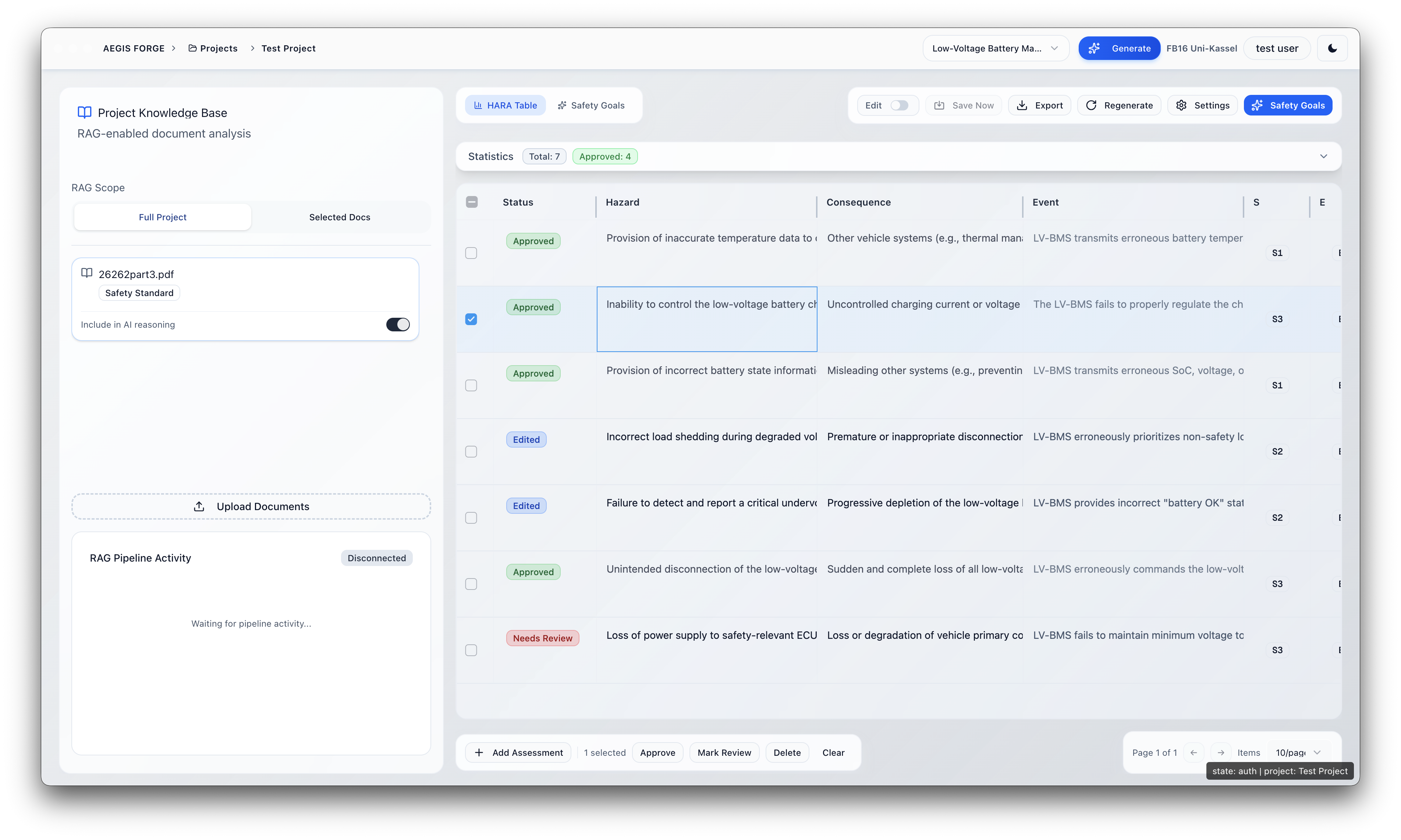
A short look at the governed engineering workflow.
See how a safety workflow moves through the platform, from project setup to traceable outputs.
Aegis SafeForge helps regulated engineering teams move from project context to reviewed HARA, TARA, requirements, CRA readiness, EU AI Act preparation, evidence, and traceability while keeping engineers in control.
ISO 26262, 21434, 62278
Multi-Industry
Platform Core
Current pilot focus
Pilot workflows focus on project context, Item Definition, HARA, Safety Goals, TARA, review queues, traceability, source grounding, and evidence readiness.
Active development
FMEA, FMEDA, FTA, ETA, HAZOP, LOPA, lifecycle dashboards, expanded reporting, and industry-specific artifacts are being developed and refined with design-partner feedback.
Expansion tracks
Additional regulated engineering profiles are being extended through configured pilots and domain-specific workflow configuration.
Aegis SafeForge is being built to help teams identify missing evidence, weak traceability, stale decisions, and open review tasks earlier in the engineering lifecycle. Instead of preparing disconnected compliance documents at the end, teams can turn scope assessments, risk decisions, requirements, controls, approvals, and evidence into governed platform artifacts as work progresses.
Aegis SafeForge does not replace legal advice, certification bodies, or conformity assessment. The platform is being developed with human oversight, traceability, cybersecurity, audit logs, source grounding, and controlled AI assistance as core design principles.
SafeForge combines controlled drafting, review visibility, evidence grounding, and linked outputs inside one industry-aware workspace.
01
Start from project definitions, uploaded documents, requirements briefs, approved artifacts, and shared engineering knowledge so the team works from a consistent context.
02
Build and review the pilot-ready automotive workflows around Item Definition, HARA, Safety Goals, TARA, FSR, TSR, and Verification Evidence. FMEA, FMEDA, FTA, ETA, HAZOP, LOPA, hazard-log, and industry-specific risk-analysis profiles are active development tracks.
03
Carry approved decisions into goals, requirements, controls, claims, validation records, incident-response plans, evidence bundles, and related outputs.
04
Give managers visibility into review queues, assignments, approvals, stale artifacts, access control, and team responsibilities without leaving the platform.
Regulated engineering teams need more than faster document generation. They need safety and cybersecurity work that moves faster, stays reviewable, and remains defensible as projects change.
AI helps teams move from project context to first-pass HARA, TARA, requirements, goals, controls, and evidence suggestions faster, while engineers remain responsible for review and approval.
SafeForge connects item definitions, hazards, threats, goals, requirements, controls, claims, evidence, and approvals during the workflow instead of forcing teams to reconstruct links later.
Review states, comments, ownership, version history, and approval decisions remain part of the engineering record, making it clearer who accepted what and why.
Source grounding, traceability, review history, and evidence readiness help teams identify missing context or weak links before reviews, audits, or customer delivery.
Aegis SafeForge is most mature today around automotive safety and cybersecurity pilot workflows. Additional domain profiles are being extended through configured pilots and industry-specific workflow models.
Functional safety and cybersecurity workflows for road-vehicle programs, starting with Item Definition, HARA, Safety Goals, TARA, review control, traceability, and evidence readiness.
Railway RAMS and cybersecurity profiles are being extended through pilots, with domain terminology and outputs designed to fit rail programs rather than forcing a generic template.
Medical-device risk-management profiles are being extended through pilots, with guided device context, structured review, and linked risk-control outputs.
Process-safety profiles are being extended through pilots for failure analysis, risk reduction, and SIL-oriented review in one governed workspace.
Platform model
SafeForge can be delivered as managed SaaS or in a more controlled environment. We align hosting, region, and operating model with your security and compliance requirements.
Regional availability, data residency, service scope, and technical architecture are confirmed during the deployment fit review.
Schedule meetingManaged
Aegis SafeForge-operated service for faster onboarding, managed updates, and a maintained production environment.
Regional
Organisations can request a preferred hosting region. EU companies can request EU servers for their SaaS environment.
Controlled
For sensitive engineering environments, we support private cloud, private VPC, and self-hosted deployment models.
AI Cybersecurity Engineering
AegisSafeForge uses structured project context and schema-constrained AI to propose TARA artifacts while lifecycle rules, dependency checks, human review, and traceability preserve engineering accountability.
Product Architecture
See how AegisSafeForge turns structured engineering context into approved HARA decisions and linked Safety Goals while preserving deterministic ASIL logic, human authority, and downstream traceability.
Product Architecture
Aegis SafeForge helps teams generate reviewable safety and cybersecurity artifacts while keeping deterministic checks, approval workflows, source evidence, and human responsibility at the center.
See how SafeForge brings item context, documents, AI-assisted HARA/TARA and requirements drafts, review decisions, and traceability into one governed engineering workflow.
Newsletter
Get product notes, event invites, and practical safety engineering articles when we publish them.